Read the opening
Introduction — Cargo Cult Agile
It's 9:14 on a Tuesday morning, and you're in the standup for Sprint 147.
Yesterday, a few people at the company, two of them on your team, got a fifteen-minute calendar invite from someone in HR they had never met. By eleven, they no longer had access to their email. Today, two names are missing from the participant list. Nobody mentions it. The Scrum Master shares her screen, the burndown chart slopes down in a perfect diagonal, and she asks the same question she asks every morning, in the tone of someone asking whether anyone wants coffee: “Okay, folks, anyone have any blockers?”
You have a blocker. The same one, for nineteen days: a ticket waiting on another team, which is waiting on a firewall exception, which is waiting on a committee that meets every other Thursday. But you’ve learned that “blocked” is a word that turns charts red, that red charts generate meetings, and that meetings generate tickets. So you say what everyone says: “Still working on the integration. No blockers.”
Silence. Cameras off. The Scrum Master says, “Perfect, thanks,” and calls the next name. The chart stays green. The product you’re building hasn’t reached a single real customer in fourteen months.
On Friday, you’ll log eight hours against a ticket for a day that consisted mostly of waiting, and you’ll choose your words carefully (“investigation,” “environment stabilization,” “alignment”), words that make waiting sound like work. Somewhere above you, a director will open a dashboard built from those words and feel, for about four minutes, that everything is under control.
You’re not crazy. You’re not lazy. And you’re not alone.
What you’re witnessing is not Agile failing. It’s Agile working exactly as your company rebuilt it to work: not as a way to deliver software, but as a ritual that lets everyone perform the delivery of software.
The book continues from here. Keep reading on Kindle.
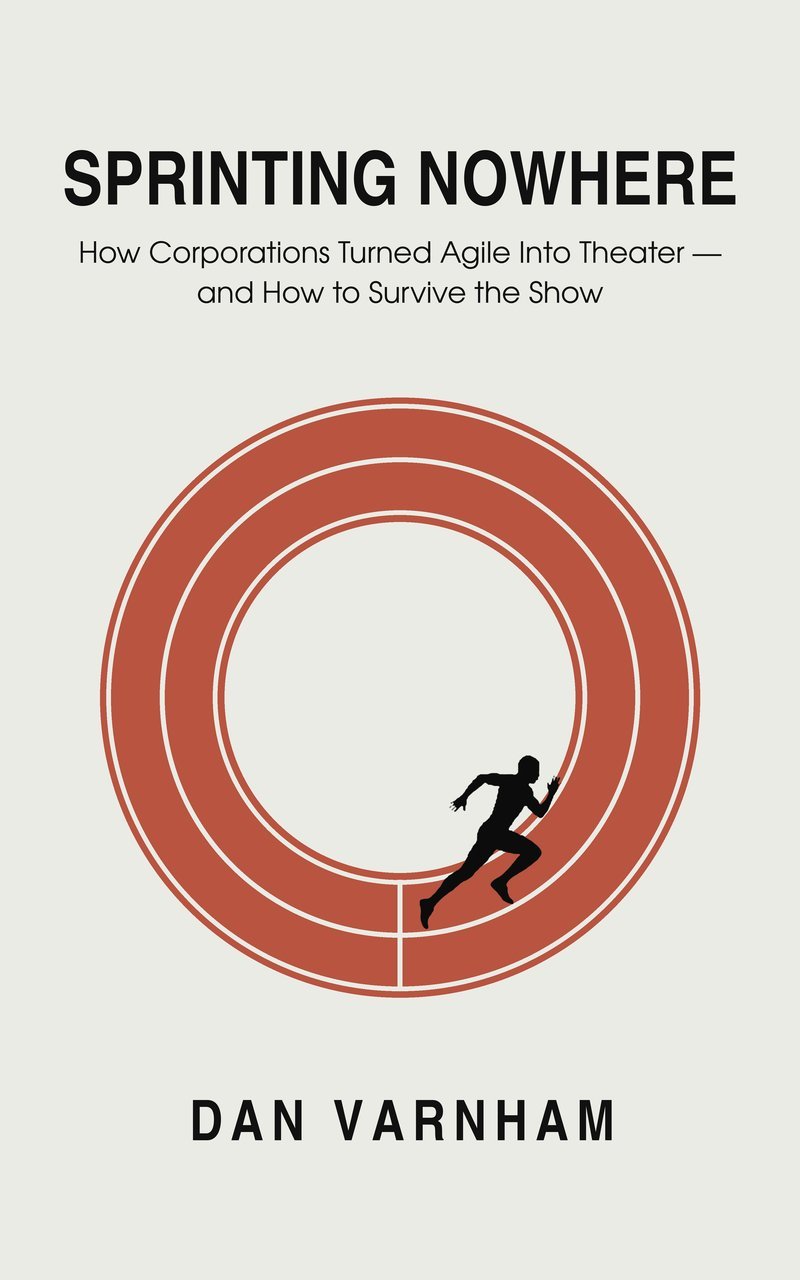
Four illusions hold the show up
-
Part I
The Illusion of Control
Timesheets, story points and green dots: metrics that soothe whoever reads them and decide nothing.
-
Part II
The Illusion of Speed
Teams that ship a lot without anyone checking what changed for the customer, and the invisible work that makes it run.
-
Part III
The Illusion of Security
Quality processes so heavy that the organization starts looking for ways around them, and pushes risk to where nobody is looking.
-
Part IV
The Agile-Industrial Complex
Transformations, certifications and tools: who gets something out of keeping the show running. Including you.
Every chapter ends with a Runbook. The Sanity Patch is for those who do the work: one small action you can take on Monday without asking anyone for permission. The Theater Audit is for those who lead: one question to find out whether you’re the jailer or the prisoner.
This isn’t a book about quitting. It’s a guide to operating the system without letting the system operate you.
From the Corporate Theater Dictionary
The book closes with a dictionary of the dialect spoken at large tech companies. The definitions aren’t official. Nor do they claim to be fair.
- Standup n.
- A fifteen-minute meeting that lasts an hour.
- No blockers phr.
- 1. A phrase said out of fear. 2. A phrase said out of strategy. Indistinguishable over the microphone.
- Velocity n.
- A number that goes up when someone asks it to.
- Owner: the team phr.
- Nobody.
- Watermelon n.
- (project) Green on the outside, red on the inside. The color of the rind is set by whoever is farthest from the fruit.
- Dashboard n.
- A permanent answer to a question someone asked once.
- Temporary adj.
- Built to outlast the permanent.
- Transformation n.
- An eighteen-month program that ends when the next one begins.
Write to the author
Questions, corrections, or a scene from your own theater: they all reach the same inbox, and every message gets read.